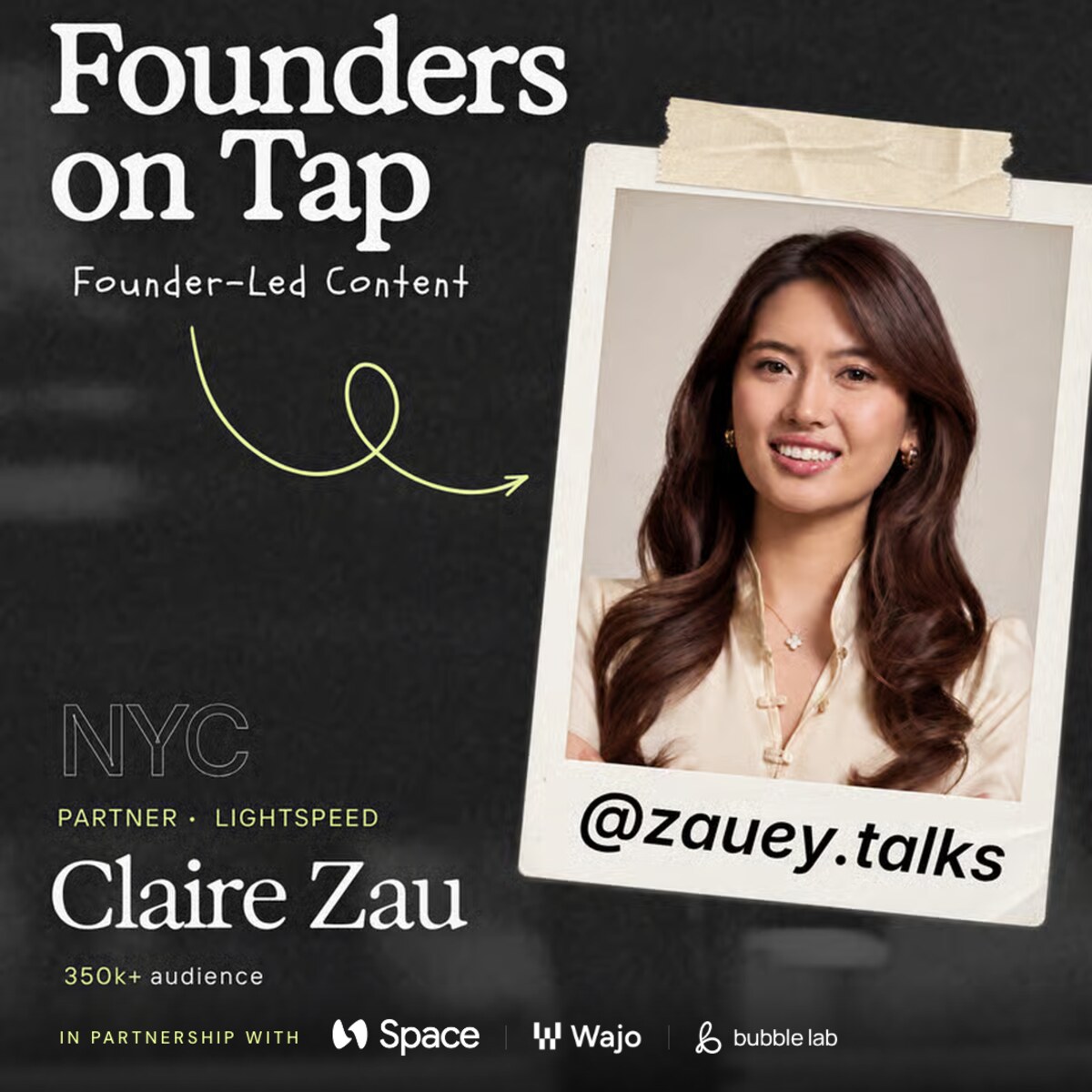
Our first NYC workshop
Founder-Led Content: How to Get People to Care About What You’re Building
Attention can help people discover your company, understand your thinking, and start a conversation. But what happens after that still depends on what you’re building.
Here’s what founders can take from the workshop.
Give your content a job
“Get more views” is a pretty incomplete goal when you’re also trying to build a company.
Claire’s slides make the distinction clear: reach can open doors and get you in front of people, but it will not close the deal. You still need substance, execution, and a good product.
There are concrete ways attention can help. When Claire posted an engineering role for a portfolio company, it received 15,000 views and 700 completed applications, according to the event page. That is a useful recruiting outcome to look at alongside the audience numbers.
Before making a post, decide what you want it to help accomplish:
01
Help potential customers understand the problem you solve.
02
Attract people who might want to work with you.
03
Make your thinking visible to investors.
04
Explain why a launch matters.
Then look for evidence related to that goal. Applications tell you something about recruiting interest. Customer conversations tell you something different. Views tell you how far the content travelled.
You need to know which question you’re trying to answer.
Build trust before you need to ask for something
One of Claire’s slides compares how trust used to travel with how it can develop through public content.
Previously, an investor’s knowledge of founders depended heavily on meetings and introductions. Reputation travelled through word of mouth. Now, founders can read an investor’s thinking before reaching out, and investors can learn about founders before the first meeting.
Claire describes reputation as a public record. She also points out that attention can compound when you consistently give value before asking for anything.
For founders, this makes content useful well before a launch or fundraising announcement.
You can share what you’re learning about your customers, explain a decision, or unpack something people misunderstand about your industry. Over time, those pieces help someone understand how you think.
Try this: what would you want a potential customer, hire, or investor to understand before meeting you? Start with one of those questions.
Your company needs a story people can understand
“Narrative is part of a founder’s job,” reads one of Claire’s slides.
The next names three audiences: buyers and consumers, employees, and investors.
That is a useful starting point because each audience needs a different reason to care.
A buyer needs to understand what the product helps them do. A potential employee needs to understand the work and why it matters. An investor needs to understand the opportunity.
Here’s a practical exercise based on that framework: explain your company in a short paragraph for each audience.
01
Customers: what problem do you solve, and what changes for them?
02
Employees: why is this worth spending their time building?
03
Investors: what opportunity do you see, and why is your team positioned to pursue it?
Keep the company consistent across all three. Change the emphasis to answer the reader’s questions.
If you’re struggling to explain it clearly, that is useful information too. Posting more often will not resolve an unclear story.
Decide how public you actually need to be
Claire asks a question that gets skipped in a lot of content advice: “Should you even be public?”
Her deck includes an “anti brand” slide and considers companies across consumer, prosumer, enterprise, and deep tech or frontier categories.
The useful takeaway is that founders have different distribution needs. A consumer company trying to reach a large audience and a specialised enterprise company trying to reach particular buyers have different people to get in front of.
Before committing to a content routine, ask:
01
Who needs to know this company exists?
02
What do they need to understand?
03
Where could they encounter our work?
04
What would a useful response look like?
That gives you a reason to choose a platform, a format, and a level of visibility.
You don’t have to copy someone else’s public presence just because their posts are doing well.
Give the audience something beyond an announcement
Claire identifies four content categories, each with a useful question to ask:
01
Educational.
What will someone understand after watching?
02
Aspirational.
What possibility will they see?
03
Entertainment.
What makes this enjoyable to watch?
04
Emotional.
What might they connect with?
These categories help turn “we should post something” into a more specific idea.
For example, an educational post could explain why a familiar problem is harder to solve than it looks. An aspirational post could show what becomes possible when that problem is solved. An emotional post could share why the problem matters to the people building the company.
Those are applications of Claire’s categories, rather than examples she prescribes.
The question to keep asking is simple: what does the audience get from this?
A company update can be useful. It still needs to make its relevance clear.
Choose your audience and depth together
Claire’s practical advice distinguishes traditional media from new media, and LinkedIn and X from Instagram, TikTok, and YouTube. She also flags breadth versus depth.
For founders, that means thinking about who you want to reach and how much explanation the idea needs.
A short piece can introduce a concept. A longer one can give someone enough detail to understand your reasoning. The right choice depends on what you’re trying to communicate.
Claire also describes rage bait and clickbait as a tradeoff.
Before using an attention-grabbing opening, ask whether the content delivers on it, whether it attracts people relevant to your company, and whether you’re comfortable with the impression it creates.
Getting someone to stop scrolling is only the beginning of the interaction.
A one-person setup still takes work
Claire shared her one-person content stack:
01
Hardware.
iPhone, DJI Mic Mini, Amazon light
02
Software.
Claude, CapCut, Descript
03
Other tools.
DJI Osmo, Meta glasses
She also shared where the time goes: editing takes the most time in her process.
That is helpful context when you see polished videos and assume someone is just recording a thought and uploading it. There is work between the idea and the finished piece.
For a founder planning to make content, the practical implication is to budget for the whole process. Coming up with the idea, making it understandable, recording, and editing all need room.
An approachable setup helps you start. A manageable process helps you keep going.
Use AI to learn. Keep your judgment in the writing
Claire says she uses AI for research and learning, rather than script writing. She also says she does not accept a one-shot AI script or set of talking points. That part of the process is highly iterative.
This is especially relevant when your content is supposed to help people understand your thinking.
A practical way to apply it:
01
Use research to understand the subject.
02
Decide which point you actually want to make.
03
Explain it out loud in your own words.
04
Find the example that makes it understandable.
05
Revise anything you would never say in a real conversation.
The tools can help with the process. You still need to recognise whether the finished piece says something you believe and understand.
That is also where your experience becomes useful. What have you seen, learned, or tried that adds something to the conversation?
Keep revisiting the product behind the story
Claire’s startup advice includes a striking planning assumption: expect to rebuild and reinvent yourself every four months, and architect for it.
She points to a technology floor that keeps shifting, model providers that can also become competitors, and a large gap between model capability and something people actually want to use or pay for.
That last distinction matters. A capability can be impressive without fitting into someone’s work or life.
For founders, a useful question to revisit is: what can the technology do now, and what does that let us make useful for our customers?
Your narrative needs to keep up with what you’re learning. So does the product.
What to try this week
Choose one audience from Claire’s framework: customers, employees, or investors.
Pick one question they need answered. Then make one piece of content that answers it clearly, using something you know from doing the work.
Give it a specific purpose and pay attention to the response. Did it prompt a useful conversation? Did someone understand the product better? Did it bring interest from the people you hoped to reach?
Claire’s workshop brings founder-led content back to a practical task: helping people understand your work before they ever get on a call with you.
You already spend time learning about your market, your customers, and your product. Some of that learning is worth sharing.
About the speaker
Claire Zau is Partner & New Media at Lightspeed, where she invests at pre-seed and seed, shapes the firm’s new media strategy, and co-hosts Lightwork, its weekly AI podcast. Previously, she spent six years at GSV Ventures, becoming its youngest partner and leading its AI investment focus. She was named to Forbes 30 Under 30 for Venture Capital.
Thank you to Space Computer, Wajo AI, and Bubble Lab (YC W26) for supporting our first NYC workshop.
This recap is based on Claire Zau’s workshop slides and the Founder-Led Content event page. The practical exercises apply the ideas in the slides.